Monday, September 28, 2015

should you use a fitness tracking app on your phone?

If you're trying to accomplish something specific, such as losing weight, gaining strength, or running a marathon, it's important to keep track of your progress.

There are scores of smartphone apps available to help you keep track. The question is: should you use one, and which one should you use?

I love tracking data, and I love technology. But these apps are only useful if they make your life better or easier.

I've been using RunKeeper to track my running for almost 5 years now. It works for me because I like having my phone with me when I run (just in case I need it), so I don't have to do anything extra except push the start button, and RunKeeper does the rest.

I've tried using LoseIt! and My Fitness Pal as food journals, but I've found myself spending too much time trying to log my foods. Since I spend most of my working day in front of a computer, it's just faster and easier to look things up online rather than on my phone.

The key is to do what works for you. Smart phone app, computer spreadsheet, pencil and paper - it doesn't matter.

Have a plan, keep track of how you're doing against that plan, and adjust as necessary. It's that simple.

- Chris Butterworth

.


.

Friday, September 25, 2015

pizza for lunch on a diet?

Absolutely!

Success comes more from how much you eat than what you eat, so you just need to eat the right amount.

Trying to find the exact calorie count for a slice of pepperoni pizza is an inexact science - I'm finding numbers ranging from 300 - 400 calories per slice at most places (330 for a large slice of Papa John's.) I usually eat slices from Barro's - they're near my office and they have a great lunch special, but since their slices are thicker and heavier than average, I'm going to ballpark a 400 calorie number from the high end of the range for my example.

Now, how much pizza can I eat?

400 calories for a thick slice of pepperoni pizza.

600 calories if you can stop at one and a half slices.

800 calories if you eat both slices.


You have to start by knowing what your calorie budget is for the day.

I burn about 1,900 calories per day without exercising, so allowing for 2,200 (give or take) on a day when I run is a fair number. If I drink a 350 calorie fruit juicee for breakfast, I can eat 2 slices of pizza for lunch, and still have over 1,000 calories available for snack, dinner, and dessert. This also gives me flexibility to adjust how much pizza I eat according to how much I'm going to eat for dinner, or whether I skipped a workout, or even if the scale showed a bigger number than usual that day.

If I was trying to lose weight, or if I was a 5' 3" woman trying to maintain weight, my daily calorie budget might be about 1,500. In that case, 2 full slices would probably be too much pizza on a regular basis, but 1 slice should be ok. I could even get away with 1 1/2 slices if I managed the rest of my day really well.

On the other hand, someone trying to keep their daily calorie intake down to about 1,000 calories would find a 400 calorie slice of pizza as their large meal of the day - a feast of a meal. But even in that ultra-restricted scenario, a half slice of pizza would be a filling way to spend 200 precious calories..

What I like about pizza - other than that it tastes awesome! - is that it's a filling use of calories. It's a good blend of carbs, protein, and fat, which gives your body plenty of short-term and long-term fuel.

So go ahead and eat some pizza. Enjoy it. Savor it. Just don't eat too much. And don't wash it down with a large soda!

- Chris Butterworth

.

200 posts ago: running for time or distance

100 posts ago: Happy Thanksgiving - my mental, physical, and emotional approach

.

Thursday, September 24, 2015

my fitness plan 092015

You're only in shape for whatever it is you're in shape for. These days I'm trying to stay generally fit - I don't have a big race on the horizon, and I'm not hiking the canyon anytime soon - I just want to stay healthy and fit.

So what's my current workout plan, and why?

Running
  • 10 miles per week, or more.
  • at least 5 runs per week (and preferably 6).
    • Mon - 2 miles fast
    • Tues - 2 miles slow
    • Wed - 1 mile fast
    • Thurs - 3 miles slow
    • Fri - 18 minutes of 1-minute intervals (one minute running fast; one minute recovering at a slow jog; repeat)
    • Sat or Sun - 2 or 3 miles slow, or a nice trail run.
  • I typically run early in the morning, first thing, before eating or drinking anything. I just get out of bed and go.
  • Stretching - I'm enjoying some stretching while cooling down after running on most mornings. This is a big change for someone as non-flexible as me - maybe one day I'll be almost flexible...


  • 3 times per week, do one or the other (alternate exercises each time)
  • 3-4 sets at a time, in rapid succession, of as many as I can do.
  • Add in some extra core work if I have anything left in the tank.
    • For pull-ups, this means knee lifts or leg raises.
    • For push-ups, I can do planks or dozens of other variations.
  • I generally do these in the evening after work.


Why this Plan?
  • The running / push-ups / pull-ups combination gives me a good mix of cardio and strength training.
  • I did this workout a lot over the summer and really enjoyed it.
  • I like how I feel when I'm in "running shape", and I like how I look when I'm in "pull-up shape".


Why these distances / reps?
  • A goal should be attainable, but not easy.
  • I've used RunKeeper to track all my runs since 1/1/2011, and the data shows I've run 10 miles in a week 20 times since then (out of 247 weeks.) I haven't run 10 miles in a week yet in 2015, and I only did it 5 weeks in all of 2014 - with the last one being in May 2014 (approx 67 weeks ago.)
    • This goal is doable, since I've done it many times in the past.
    • But it won't be easy, since I haven't been able to do it very often. Getting 10 miles in on a consistent basis will be challenging, and hopefully rewarding.
  • As for the reps on push-ups and pull-ups - I want to feel sore enough to know I worked out, but not too sore to be comfortable the next day. I also want to get stronger over time, but I don't need to look like a body builder to feel successful. Enough is enough - no need to overdo it.
  • I wrote about the optimal amount of exercise a few months ago - this should be more than enough to stay fit and healthy, without being excessive.
  • I'm thinking this might be a worthwhile plan for the next year, but I'm going to commit myself to it for the next 10 weeks, and re-assess from there.


Eating is King

As always, diet has a larger impact on weight than exercise, unless you're working out for several hours a day. So I'll want to continue to eat a reasonable amount of real foods (or as close to real as practical) to maintain my target weight. Running several days in a row does not give one free license to eat unlimited amounts of fast food!

So there you have it.

Simple, but not easy. Attainable, but not without consistent dedication. And rewarding - I should be in "fit and healthy" shape when my 10 weeks are up (the week after Thanksgiving, coincidentally, and speaking of eating reasonable amounts...)


- Chris Butterworth

.


.

200 Posts ago: Fit-20 Workout 06-27-12


.

Friday, September 4, 2015

which is the healthiest bread?

I started thinking about this article while enjoying the irony of a peanut butter and jelly sandwich on toasted artisan-crafted bread. (believe me, it was a really good PB&J..)

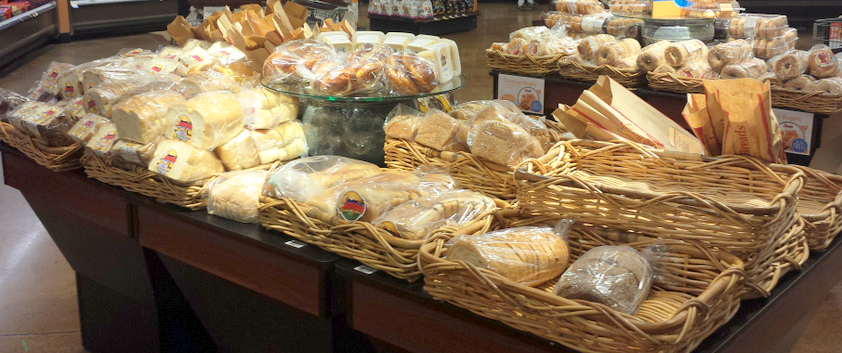
What is bread, really? At it's most basic form, and it's been around for thousands of years, we're talking about milled grains (wheat), leavening agents (yeast), and water, mixed together and heated (1). Yet considering what a simple product it is, there are so many choices at the grocery store it makes my head spin!

Why so many? And which one should I be eating?


Some quick thoughts about bread:
  • Prices range from really cheap (about $1 per loaf) to really expensive ($5 or $6 per loaf). Feeding a family who eats lots of sandwiches at $6 for a small loaf seems excessive - buy the bread you can afford.
  • Cheaper options tend to have more man-made ingredients in them; this helps the bread last longer before going bad.
  • More expensive (and healthier) options tend to have ingredients you've heard of, such as flour, water, salt, and yeast. Maybe they'll add some nuts, garlic, herbs or spices, but it'll still be whole ingredients that you know what they are (2).
  • Whole wheat, fortified, organic, multi-grain, 11 grain, white, wheat, sourdough, rye, gluten-free, artisan...
  • Lots and lots of choices

More thoughts about bread:

  • Buy what tastes good. If you buy the ultra-organic, 46-grain bread with all the healthiest nuts and seeds baked into it, but then you don't eat it, why bother?
  • Eat bread with fewer, if any, man made ingredients.
  • Don't get caught up in the arms race to healthiest, because you can't win.
  • Your bread is simply a nutrient delivery tool - what you put ON your bread will have a much bigger impact than what is baked IN your bread. (plus all the other food choices you make throughout the day.)
  • If you're eating the super-healthy, most expensive bread because it has 3 grams of fiber, consider that's less fiber than a serving of broccoli (about 5 grams), raspberries (8 grams), or lentils (15 grams) (3). Maybe you could scale back the bread and pair it with a better side dish?

In the end, there is no perfect choice. There are better choices, sure, but there's no such thing as perfect. Eat moderate portions of real foods, and mix in some exercise, and you'll be on the road to healthy.

Meanwhile, all this talk about bread has me craving a turkey sandwich on sourdough with havarti, lettuce and tomatoes...

- Chris Butterworth

Sources cited:

.


Thursday, September 3, 2015

around the web 090315

I've read a few articles this week that were interesting enough to share..

Caffeine Crisis

Caffeine has been the stimulant of choice around the world for thousands of years. Now, suddenly, Americans are overdosing on caffeine in record numbers.

Here's the full story:

How America’s love affair with caffeine has sparked a crisis of overdoses — and what the FDA is trying to do about it


More calories end up in those "bring your own grocery bags."

A study of thousands of grocery store shoppers found that those who brought their own "good for the environment" bags purchased more organic foods. They also bought more cookies!

Here's the full story:


Omega-3 fish oil supplements do not boost brain activity

After studying 4,000 elderly subjects over a 4-year period, researches have determined that any perceived benefit from taking fish oil supplements is only a myth.

Per the article: "It is possible that eating foods rather than taking any specific single supplement may have an effect." Further study on this is needed.

Here's the full story:


Have a great Thursday,

- Chris Butterworth

.


Monday, August 31, 2015

keeping a food journal

The only way to be sure you're eating fewer calories than your body burns is to know exactly what you're eating (and how many calories your body burns at rest). And the only way to know exactly what you're eating is to keep track of it.

This is especially true when you are just starting out on your road to losing weight. Your internal, "gut feeling", of how much to eat is out of balance - writing down what you eat and paying close attention to it will help you re-calibrate your gut feeling.

It doesn't matter what format you use; it only matters that you know, with absolute certainty, that you've eaten fewer calories than your target number.

Here are a few types / options to consider:

Spiral ring notebook. It's a little old fashioned, but it still works great. Boot-up time is zero; just open it and start writing.

Computer program. Your computer may not be portable and always at your side, but if you sit in an office all day this can be a great place to keep your food journal.

Spreadsheets, word processing programs, or a note taking application like Evernote or Onenote all work equally well.

Many of these programs are easy to integrate with your phone, so you can use your phone as well as your computer.

Smartphone app. Your phone is always with you, just waiting to do your bidding. You can input the details of your lunch as soon as you've finished eating, wherever your are.

Most of the apps I've sampled also come with a food-lookup option, so you can determine how many calories your lunch had from within the app itself.

Many of the apps have online access as well, so you can view and edit your food journal from your computer, and keep track of your history, from that larger screen in your office.

Bottom line

There are many different methods you can use to keep track of what you're eating. It doesn't matter which one you use, only that you use one.

Can you splurge a little bit at dinner, or have a brownie for dessert? Guessing at the answer could be the difference between losing weight and not.

- Chris Butterworth

.

Thursday, August 27, 2015

mediocre is the opposite of excellence

Terrible seems like it would be the opposite of excellence, but terrible is easy to fix.
  • You didn't workout last week? Pick yourself up and get back on track.
  • You've been eating everything in sight? Stop. Take a breath. Regroup. Re-assess your plan. And get back on track.


Mediocre is much more difficult, in part because you might not even notice it.
  • You've been working out, but maybe not with your desired level of intensity. Or maybe you're getting to the gym sometimes, but not as often as you had planned.
  • You're eating pretty well, paying attention to what you order, where you eat, and how often. But you're not losing any weight. Maybe you're rounding up on your calorie counts, or you might be grabbing a handful of snacks without even realizing it.


It's hard to get down on yourself when you're trying, and mediocre masks how hard you're trying.

Mediocre is frustrating. It robs you of your results. It fills you with hopelessness, and makes you want to give up, because you think you're doing the work but you're not seeing the results.

Changing your habits, and your body, and your health, is hard. It takes commitment, and it takes excellence.

Pay very close attention to your actions, and to your results. Keep a journal. Be reflective. Are you reaching excellence, or merely mediocre?

- Chris Butterworth

.